
What Happens to Human Capital After Deportation?

Updated: Nov 4
By Israel Concha | Founder and Executive Director of New Comienzos
October 27, 2026

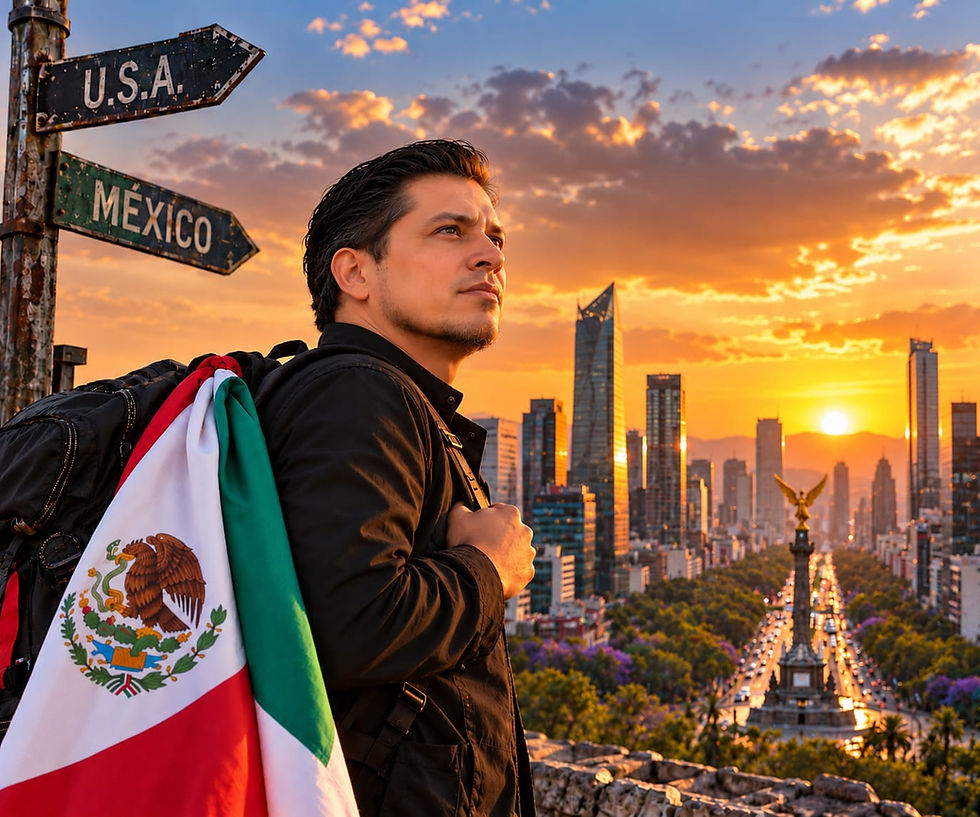
Concept image of the New Comienzos Community Reintegration Laboratory in Little L.A., Mexico City.
For decades, millions of Mexican immigrants built lives in the United States. They raised families, learned English, built careers, opened businesses, managed teams, developed professional skills, paid taxes, supported communities, and gained years—sometimes decades—of experience inside the U.S. economy.
When deportation or return occurs, that human capital does not disappear at the border.
The language skills do not disappear. The professional knowledge does not disappear. The work ethic, leadership experience, cultural understanding, business connections, and ability to navigate two countries do not disappear.
Yet there is often no coordinated system to help people translate those assets into a successful life in Mexico.
A human-capital problem hiding inside the migration debate
A person may return to Mexico after 15, 20, or 30 years in the United States and suddenly discover that the experience they spent a lifetime building is difficult to explain, validate, or transfer.
A bilingual supervisor can become an entry-level applicant. An experienced construction worker may have no recognized certification. Someone who managed a business in the United States may not know how to establish one in Mexico. A professional with strong English and years of U.S. work experience may arrive with no local network.
This is more than an immigration issue. It is a workforce issue, an economic-mobility issue, and a human-capital issue.
The United States helped shape much of this talent through workplaces, schools, industries, and communities. When people return to Mexico, that accumulated experience should not simply be lost.
New Comienzos was created from inside this community
New Comienzos was created by members of this community, not by people studying deportation from a distance.
For more than a decade, we have worked alongside deported and returned individuals rebuilding their lives in Mexico after years or decades in the United States.
During that time, we have accumulated something just as important as a list of services: firsthand knowledge about where reintegration succeeds, where it fails, and what people actually need during the transition.
We have helped people navigate employment, education, mentorship, emotional support, legal referrals, language programs, workforce preparation, and community resources. But the deeper lesson has been clear: successful reintegration rarely depends on a single service.
A job alone is not reintegration. A government document alone is not reintegration. A training course alone is not reintegration. Successful reintegration requires an ecosystem.
The next step: turn experience into a model
The Community Reintegration Laboratory is designed to become a real-world testing ground for how deported and returned Mexicans can convert U.S.-acquired experience, language skills, and professional knowledge into economic mobility in Mexico.
The goal is not simply to create another service center. The goal is to turn more than a decade of community experience into a measurable and replicable model.
The Laboratory will combine a physical presence in Mexico City with digital tools, structured support, employer partnerships, mentorship, research, and measurable 30-, 60-, and 90-day reintegration pathways.
Instead of asking whether a program feels successful, we want to measure outcomes.
How quickly can someone move toward stable employment? Can U.S. experience translate into better opportunities in Mexico? Can bilingual skills lead to higher wages? Can mentorship reduce isolation? Can employers become better at recognizing returned talent? Can entrepreneurship become a realistic pathway? Can a coordinated reintegration process improve long-term stability?
Those are not abstract questions. They are questions we can test, measure, and improve.
Why a laboratory?
The word laboratory is intentional.
We want a place where community members, universities, companies, nonprofit organizations, researchers, and public institutions can work together to understand what successful reintegration actually looks like.
Programs can be tested. Outcomes can be measured. Employer partnerships can be developed. Workforce models can be improved. Technology can be integrated. Community-based solutions can be documented.
And when something works, it can be replicated.
The Little L.A. area of Mexico City is a natural place to build this work because deported and returned Mexicans have already created community, businesses, networks, and a shared identity there. The Laboratory can help turn that lived experience into knowledge that benefits people far beyond one neighborhood.
Why this matters to U.S. donors
Reintegration is not only a Mexican issue. It is deeply connected to the United States.
Many returned Mexicans spent most of their adult lives in the U.S. Their children may still live there. Their employers may have been American companies. Their professional training may have taken place inside the U.S. economy. Their families, communities, and economic lives remain binational.
That makes reintegration relevant to American philanthropy, universities, employers, and institutions working in workforce development, education, immigration, economic mobility, family stability, and community development.
A founding partner would not simply be funding services for one group of people. They would be helping build the evidence, infrastructure, and methodology for a reintegration model that could eventually be replicated elsewhere in Mexico.
The investment is not only in assistance. It is in learning what works—and building a system around that evidence.
From returnee to contributor
People returning to Mexico are not starting from zero.
They return with experience, language, knowledge, resilience, connections, skills, and ideas.
The challenge is often not that they have nothing. The challenge is that there is no coordinated system designed to recognize what they already have and connect it to opportunity.
For decades, we have measured deportation by how many people leave the United States. Perhaps it is time to begin measuring something else: what happens to their talent after they come home.
If we can learn how to preserve that human capital, connect it to opportunity, and build a model that others can replicate, reintegration can become more than a response to deportation.
It can become an investment in people.
That is the work New Comienzos is preparing to build through the Community Reintegration Laboratory in Little L.A., Mexico City.
Returning is not a failure. And the experience built in the United States should not be lost at the border.



Comments